2nd Workshop Critical Audiovisual Heritage
23 april 2026, 19:30-21:30 - Occlusions : Black Memory Disclosures (Filmtheater Kriterion) Amsterdam
24 April 2026, 09:30-17:00 – International Institute of Social History (IISH), Amsterdam
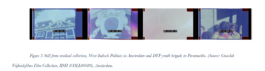
As part of the AHM/ASCA research initiative Critical Audiovisual Heritage (2024–29), this one-day workshop takes the audiovisual collections of the International Institute of Social History (IISH) as a case study to explore how large-scale digitisation reshapes access, reuse and collaboration around political and social-movement-related audiovisual materials. Building on a previous workshop on AV archives and anti-colonial film material organised at Framer Framed, this second workshop explicitly links questions of activist heritage and memory to ongoing digitisation initiatives at IISH.
Filmmakers, researchers, archivists, students and activists are invited to engage with digitised materials from an archive whose audiovisual collections include documentaries, unedited film recordings, and newsreels covering political movements and labour struggles. The workshop asks how digitisation strategies affect the work of AV archivists and other stakeholders of collections and how they currently engage – or wish to engage – with communities whose histories and struggles are represented in these collections.
Among other central questions is whether community input should not only enrich collections - for instance through additional description or context - but also inform and constrain access and reuse policies, particularly when dealing with politically sensitive materials. Who gets to decide what counts as “politically sensitive”? How are such sensitivities labelled in catalogues and databases? In the context of creative reuse, how do filmmakers and artists position themselves in relation to these questions; to what extent are they entitled to reuse politically charged content for new purposes, and what responsibilities follow from such reuse?
The day is structured in two parts. The morning session provides context on the research initiative and presents related efforts and projects. The afternoon session consists of two parallel breakout sessions, each addressing a specific theme:
Morning session @ Netlau (09:30–12:00)
Welcome & introduction
IISG presentations From Shelf to Screen: Processing AV Collections through Selection, Digitisation, Appraisal and Description
Nina van den Berg (Staff Member Public Services)
Robert Gillise (Digitisation specialist)
Bence Meijer and Harriet Stroomberg (Staff Members Processing and Access)
Case study
Challenges in the Digitisation of Activist Audiovisual Collections at IISG
Fidel Enciso Durán
Guest talk
Creative Archival Reuse at NISV (Netherlands Institute for Sound & Vision)
Cees Martens
Keynote
Listening Between the Gaps: Fugitive Historiography and the Audiovisual Archive
Amanda Egbe
12:00-13:00 Lunch break : Lunch will be provided @Nettlau
Afternoon session (13:00–15:45)
Breakout Session 1 – Collaboration & Reuse @Nettlau
Focus: Tensions between activist “source communities” and filmmakers.
Leads: Luna Hupperetz, Amanda van Hesteren
Taking the Unknown Suriname residual collection and ongoing community led digitisation with former LOSON activists as its starting point, this session examines how politically charged images circulate between activist source communities, filmmakers and archival institutions. Through small group discussions and creative reuse experiments, participants identify tensions and develop principles for community-accountable reuse and presentation of activist audiovisual materials. Drawing on Baron’s concept of the “archive effect” (2014) and Khouri and Salti’s notion of an “unsettled past” of activist memories (2019), the session explores differing user needs and responsibilities in working with activist audiovisual archival material.
- This session is especially relevant for filmmakers and will include the participation of two members of Projectgroup Oema foe Sranan. Please note that this breakout session will be conducted in Dutch.
Breakout Session 2 – Digitisation, Scale & Communities @Posthumus
Focus: How digitisation strategies shape archival work, access and community engagement.
Leads: Christian Olesen, Fidel Enciso Durán
Taking IISH's recently launched digitisation project as a starting point, this session considers questions and issues of archival description and care in the context of large-scale digitisation workflows. During the session, we will dive into recent examples of titles and sub-collections digitised, with attention to the access enabled by the archival description and the circulation of their associated metadata in different online contexts (among others, IISH online resources and The CLARIAH Media Suite). As part of this discussion, we will also consider examples of alternative modes of presentations pertaining to notions such as “counter-archives”, “rogue” archives (De Kosnik, 2016), “anarchival film” (Goddard, 2019), and “little databases” (Snelson, 2025).
Plenary session @ Nettlau (16:00–17:00)
Drinks @ Nettlau (17:00-18:00)
This event has passed.
Thank you for your interest. Registration for this workshop is now closed.
Practical information
- Date & time: 24 April 2026, 09:30–17:00
- Location: International Institute of Social History (IISH), Amsterdam
- Registration:
- If you wish to attend the workshop, please send an email to Luna Hupperetz at l.m.l.hupperetz@uva.nl with the subject line “Critical AV workshop”. (Seats will be distributed on a first-come, first-served basis) In your message, please indicate the following:
- Your name, affiliation, and field (e.g. film/media studies, archival studies, history, memory studies)
- Your preferred breakout session (“Breakout Session 1” or “Breakout Session 2”)
- Whether you would like to be considered for travel-cost reimbursement (for participants based outside the Netherlands). A limited budget is available and we will prioritise researchers whose work closely aligns with the workshop themes.
- If you wish to attend the workshop, please send an email to Luna Hupperetz at l.m.l.hupperetz@uva.nl with the subject line “Critical AV workshop”. (Seats will be distributed on a first-come, first-served basis) In your message, please indicate the following:
8 May 2025
A Cutting Room Floor: Practices & Methods of Disclosing Militant Cinema
On 8 May 2025, Framer Framed co-hosted the conversation A Cutting Room Floor: Practices & Methods of Disclosing Militant Cinema which aims to discuss strategic practices of anti-colonial audiovisual collections. Fragments and documents associated with two projects from Cineclub Vrijheidsfilms will be screened: the film Guadeloupe Answers Back (1967) and the residual collection of Unknown Suriname (1973-1979).
